
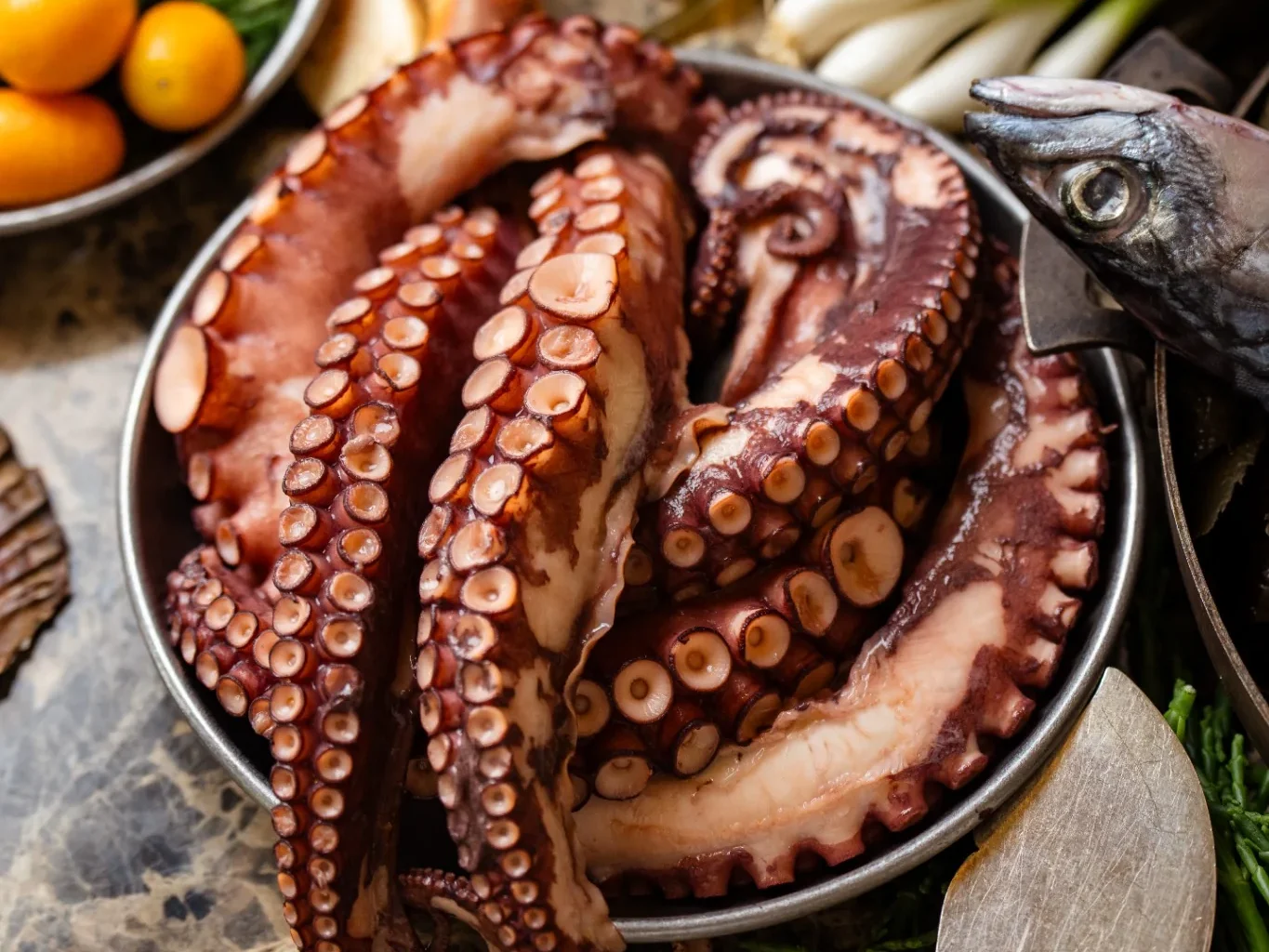
Britain’s coastline has always given us plenty to get excited about. It also has a habit of reminding us that we don’t control what happens beneath the surface. The remarkable rise in octopus around the South West is the latest example, bringing opportunities for some fishermen and real difficulties for others. For restaurants like ours, it raises questions that deserve a little more thought than simply adding another dish to the menu.
Most of us associate octopus with a table somewhere overlooking the Mediterranean. A long lunch, something cold in the glass and very little urgency about what happens next. Finding it closer to home might come as a surprise, but the common octopus is native to British waters. What has changed is the number being seen, particularly around Devon and Cornwall.
The bloom that attracted attention in 2025 has continued into 2026. Fishermen and divers have been reporting an extraordinary increase, and the Marine Management Organisation is monitoring both octopus landings and the effects on other fisheries. This is a significant change happening on our own doorstep. Marine Management Organisation.
To understand what that means for dinner, we first need to understand a little of what it means for the sea.

The common octopus, Octopus vulgaris, generally favours warmer waters further south. Research led by the Marine Biological Association links the recent bloom to unusually warm sea temperatures, with winds and currents also likely to have helped carry young octopus across from the Channel Islands and northern France.
There is history here too. Major blooms were recorded in 1899–1900, 1932–33 and 1950–51. So this has happened before, although the warming of our seas gives the latest event a context we cannot ignore. Researchers have also recorded widespread breeding and young octopus, raising questions about how established these populations might become. Marine Biological Association.
An abundance of something delicious might sound like straightforward good news. For the people working these waters, the picture is rather more complicated.
Octopus eat crab, lobster and other shellfish. They can enter fishing pots and help themselves to the catch, leaving the fisherman with very little to show for the work. Some boats have been able to earn money from octopus themselves; others face losses in the fisheries their businesses were built around. That matters enormously in coastal communities, where a change beneath the water quickly becomes a change to someone’s livelihood. Marine Biological Association: the effects on fishermen.

Supporting those communities means being willing to understand what they are dealing with. A restaurant menu should have enough flexibility to respond.
It also means resisting the temptation to turn abundance into a blanket sustainability claim. Plenty of octopus in one place, at one moment, does not answer every question about catching them. The Cornwall Good Seafood Guide notes that local stock status remains uncertain and that octopus populations can fluctuate considerably. Their fast growth and reproductive capacity are relevant, but so are the gaps in our knowledge. Cornwall Good Seafood Guide.
For me, that is where the useful conversation starts. Where has something come from? How was it caught? What else was affected in catching it? And would we make the same decision if the circumstances changed?
At Faber, our approach centres on British seafood, day boats and a menu that responds to availability. We do not buy from trawlers. Those choices give us a starting point, but the work sits in the detail of each fishery and each supplier. A small boat still needs to be using an appropriate method, and a carefully caught fish still comes from a population we need to look after. Our journal’s discussion of fishing methods explores why those details matter.

The same questions apply to octopus. Catching one in a pot and catching one with fishing gear dragged across the seabed can carry different environmental consequences. Neither the word “British” nor the name of the species tells the whole story.
There is also the animal itself to consider. Octopus are remarkable creatures, and the evidence for their capacity to experience pain and distress deserves to be taken seriously. A major review led by the London School of Economics examined that evidence across hundreds of studies. LSE’s review of animal sentience.
An abundant population does not make welfare questions disappear. Capture, handling and dispatch all belong in the discussion. We should be able to explain the choices behind a plate, including where there is still more to learn. Some guests will decide that octopus is something they would rather not eat, and that is a perfectly reasonable choice.
These are the challenges of running a seafood restaurant with principles. There will always be ingredients people expect to see, dishes they would like us to keep and easier ways to write a menu.
We have chosen to leave salmon and tuna off ours. We work with alternatives such as British trout, and accept that availability shapes what we can offer. It asks a little more of the kitchen and sometimes a little flexibility from the guest, but it also gives us the chance to introduce something they might never have ordered otherwise. Faber’s Earth Day journal sets out those choices.

The responsibility carries on once the delivery has arrived. Fish bones become stock, usable trimmings earn their place elsewhere in the kitchen, and a focused menu helps us make better use of what we buy. Water filtered and bottled on site avoids a stream of single-use bottles. These are practical decisions with a place in the daily running of the business, as we described in our approach to creating Faber.
They also have to work commercially. A restaurant needs to pay its team, pay its suppliers and offer something people want to come back for. Finding improvements we can sustain is part of the job. So is admitting when something needs another look.
The octopus bloom brings all of this into view. Changing seas, pressure on fishermen, an unfamiliar abundance and difficult questions about how we respond. Buying what is available can help coastal businesses adapt, provided we keep asking how it reaches us and avoid building expectations that the sea must then meet indefinitely.
We are lucky to have an extraordinary coastline and people who know its waters far better than most of us ever will. Listening to them, alongside the researchers studying these changes, is essential.
Faber gives us a place to bring that knowledge to the table. Hopefully with something delicious, a good glass alongside it and a conversation that leaves us all a little more curious about what is happening around our shores.
Here are eight simple yet delicious dressings that pair perfectly with fresh oysters, each designed to complement their natural flavour without overwhelming it.
Read moreThis year, why not surprise your guests with these five exquisite seafood-inspired recipes that are as celebratory as they are delicious?
Read moreAlcohol free cocktails made for all tastes and still using British coastal ingredients.
Read more