
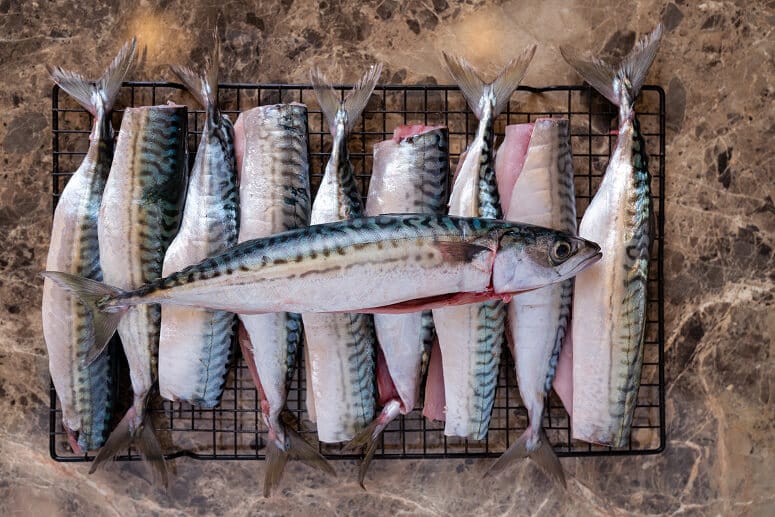
In summer it flashes silver and blue through our coastal waters, arriving in shoals that have sustained coastal communities for generations. Along the south coast, in Cornwall and Devon, small boats have long followed these seasonal runs, bringing the fish ashore fresh and quickly to market. Grilled over fire, cured lightly or eaten simply with lemon and sea salt, mackerel has always been one of the great pleasures of the British seas.
Yet even a fish as familiar as mackerel can become the centre of a much larger conversation about sustainability.
In recent years the Northeast Atlantic mackerel stock has come under increasing scrutiny. The issue is not the species itself, which remains relatively abundant, but rather the way in which the fishery is managed between several nations sharing the stock. Mackerel migrate widely across the North Atlantic and are fished by fleets from the UK, Norway, Iceland and the Faroe Islands. In recent years disagreements over quota allocations have led to catches that exceed the levels recommended by fisheries scientists.
It was against this backdrop that Waitrose announced its decision to remove Northeast Atlantic mackerel from sale. A move now being followed by many of their peers.
The retailer explained that the move was intended to highlight concerns about the way the fishery is currently managed and to encourage governments and industry bodies to reach an agreement that aligns catches with scientific advice. It was a decision that attracted considerable attention, raising questions not only about the health of the stock but also about how retailers and restaurants should approach species caught within complex international fisheries.
Importantly, the concerns raised by retailers are largely about scale and management, rather than the inherent sustainability of the fish itself.
Much of the mackerel sold through large retail supply chains is caught by large pelagic trawlers using mid-water trawl nets capable of catching vast quantities of fish in a single haul. These vessels operate across international waters and land fish into global markets. While mid-water trawling for mackerel generally has relatively low bycatch compared with many fisheries, the scale of these operations means they are closely tied to the wider quota disputes affecting the stock.
For smaller coastal fisheries, the picture can look quite different.
Along the southwest of England, mackerel are still caught by day boats using traditional low-impact methods such as handlines and small-scale hook-and-line gear. These boats typically leave harbour in the early morning; fish close to the coast and return the same day with relatively modest catches. Each fish is caught individually, resulting in extremely low bycatch and minimal seabed impact.
This style of fishing is slower, seasonal and inherently limited in scale. It is also deeply embedded in the coastal food culture of Britain.
At Faber we have always been interested not only in the species we serve but also in the way they are caught. Fishing method, scale and seasonality are just as important as the fish itself. For that reason, we continue to source mackerel from small day boats operating along the south coast and in the Southwest, where the fish are landed fresh and handled with care.
When caught in this way, mackerel remains one of the most sustainable wild fish available in British waters.
It is a fast-growing species, matures quickly and reproduces in large numbers. When harvested in small volumes by low-impact fisheries, it represents exactly the kind of seasonal, local seafood that coastal restaurants have relied upon for generations.
This distinction between industrial scale fishing and small scale dayboat coastal fishing is an important one.
Large retailers understandably make decisions based on global supply chains and large volumes of fish moving through international markets. Restaurants, particularly those working closely with smaller producers and fishermen, often can operate on a more local and transparent scale.
For us, that means continuing to celebrate mackerel when it is available from the right sources.
Caught by handline, landed the same day and served in season, it remains one of the great fish of our waters’ rich, vibrant and unmistakably tied to the British coast.
As with so many ingredients, the real question is not simply whether we should eat it, but how it reaches our plates.
Here are eight simple yet delicious dressings that pair perfectly with fresh oysters, each designed to complement their natural flavour without overwhelming it.
Read moreThis year, why not surprise your guests with these five exquisite seafood-inspired recipes that are as celebratory as they are delicious?
Read moreAlcohol free cocktails made for all tastes and still using British coastal ingredients.
Read more